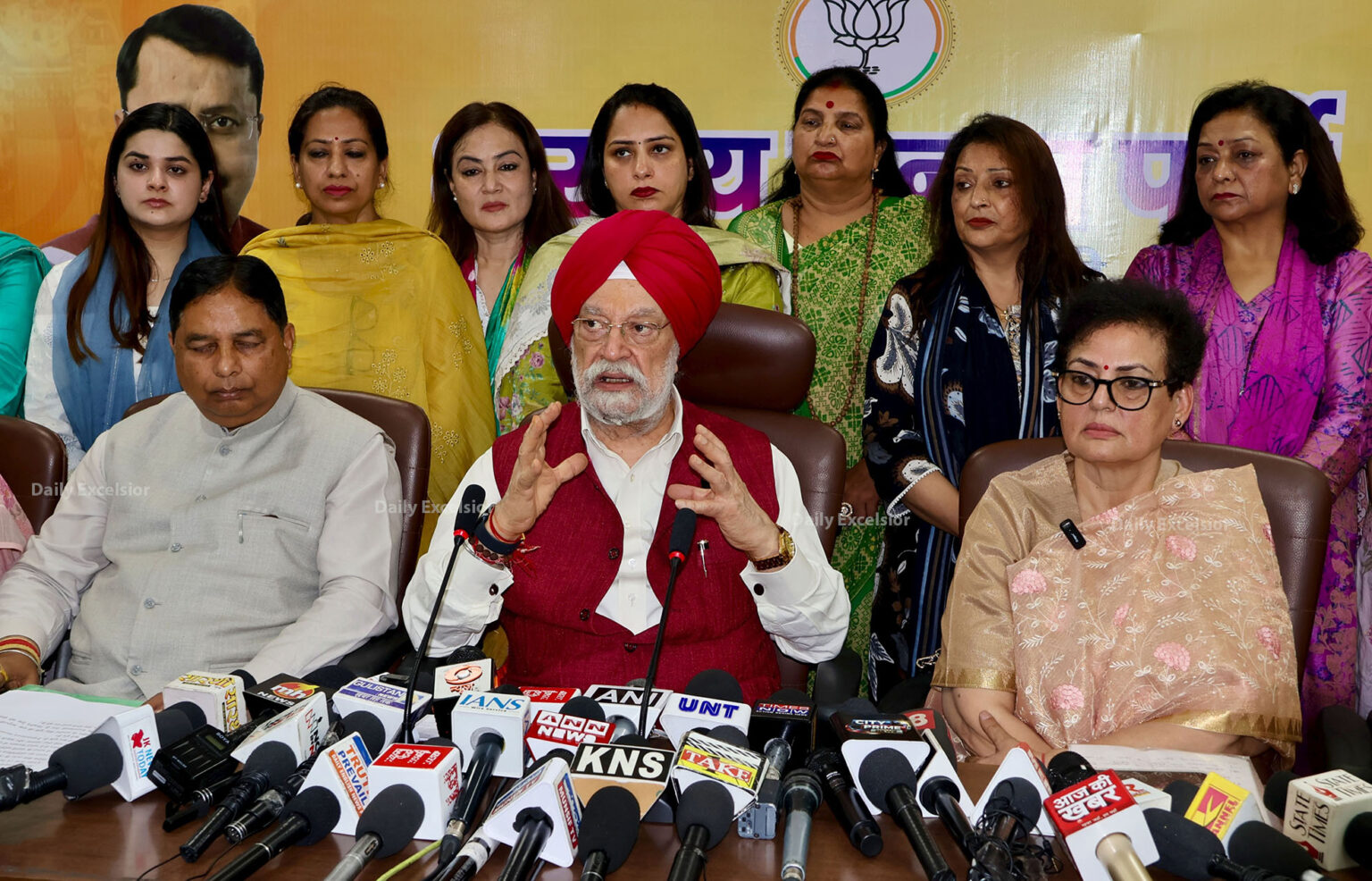
Jammu: Intensifying the political debate over the Women’s Reservation Bill, Hardeep Singh Puri on Sunday alleged that the Congress opposition and its allies “hatched a conspiracy” to block the landmark legislation in Parliament. Addressing a press conference, Puri said the government made repeated efforts, including last-minute outreach, to accommodate opposition concerns but these were rejected, resulting in what he termed a deliberate attempt to stall a historic reform.
Puri said even appeals made by Home Minister Amit Shah for constructive engagement were ignored. “They were not interested in dialogue. This was a calculated move to derail the Women’s Reservation Bill,” he said, adding that parties such as Congress, DMK, TMC and the Samajwadi Party were opposed to implementing the measure before the 2029 elections.
Describing the bill as a “transformative step” in India’s democratic journey, Puri emphasised that it seeks to ensure 33 percent reservation for women in Parliament and state legislatures, marking a shift from welfare-driven policies to women’s empowerment through political participation. He reiterated that the BJP has consistently supported the proposal since 2014, when it was included in the party’s manifesto.
Highlighting the government’s track record, Puri pointed to several initiatives aimed at improving women’s lives, including the construction of nearly 11 crore toilets and close to three crore houses under the Pradhan Mantri Awas Yojana, many registered in women’s names. These measures, he said, demonstrate the Centre’s broader commitment to advancing women’s empowerment beyond legislation.
Addressing concerns around delimitation, Puri clarified that it is a necessary step for implementing the Women’s Reservation Bill. He dismissed opposition claims that southern states would be disadvantaged, asserting that parliamentary data shows proportional seat increases across regions. “There is no north-south divide. These claims are misleading,” he said, accusing the Congress opposition of spreading misinformation.
Former National Commission for Women chairperson Rekha Sharma strongly criticised opposition parties, calling the bill’s defeat “shameless” and likening it to a “foeticide of women’s rights.” She alleged that Congress has blocked the legislation for decades through shifting demands and procedural hurdles. “Their intention was never to pass the bill,” she said, noting that women’s representation in Parliament has only risen from around 3 percent to about 14 percent over the years.
Jammu and Kashmir BJP president Sat Sharma echoed similar sentiments, accusing opposition parties of hypocrisy on women’s issues. He said their actions have exposed “double standards” and reaffirmed that the BJP will continue its outreach to ensure the implementation of the Nari Shakti Vandan Adhiniyam. “The people of India, especially women, are watching closely and will hold them accountable,” he said.
Puri warned that blocking the Women’s Reservation Bill amounts to a betrayal of women’s aspirations and a setback to democratic reform. He added that if Parliament remains stalled, the government is prepared to take the issue directly to the public, reflecting what he described as the “national mood” in favour of women’s political representation before 2029.
The controversy has brought renewed attention to the importance of institutional reforms aimed at gender equality in politics. As debate continues, the bill remains central to discussions on accountability, representation, and the future of women’s empowerment in India, with its outcome likely to shape the political narrative in the years ahead.