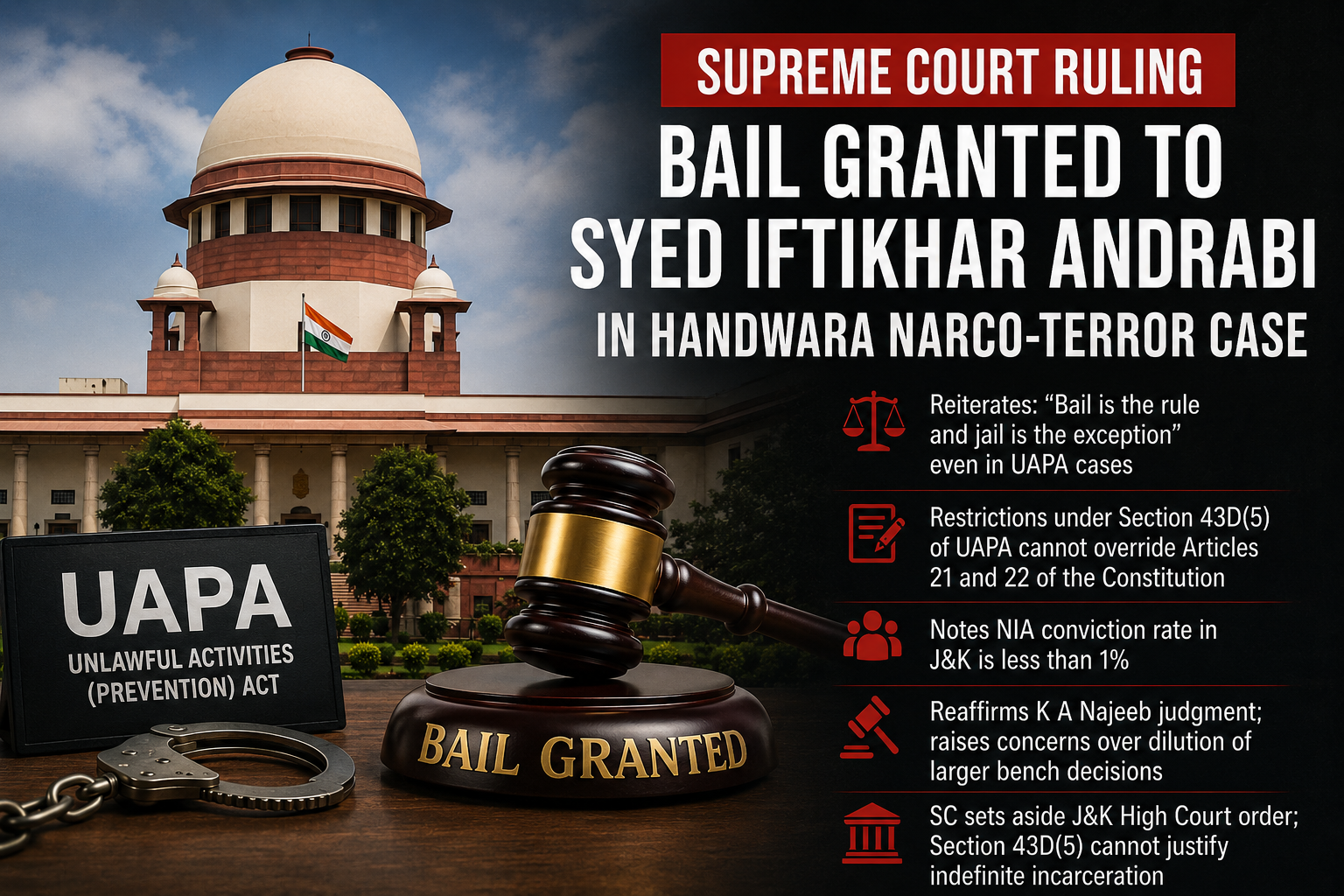
New Delhi: In a significant judgment with far-reaching implications for UAPA cases, the Supreme Court on Monday granted bail to Syed Iftikhar Andrabi, an accused in the Handwara narco-terror case, while reaffirming that constitutional liberties cannot be overshadowed by stringent anti-terror laws.
A bench of Justice B V Nagarathna and Justice Ujjal Bhuyan, delivering a judgment authored by Justice Bhuyan, held that the restrictions on bail under the Unlawful Activities (Prevention) Act (UAPA) must be balanced against the fundamental rights guaranteed under the Constitution, particularly the right to personal liberty and speedy trial.
The case relates to RC:03/2020/NIA/JMU, investigated by the National Investigation Agency (NIA).
Setting aside the Jammu & Kashmir and Ladakh High Court’s earlier order denying bail, the apex court observed that the seriousness of allegations and the existence of a prima facie case cannot justify keeping an undertrial in custody indefinitely.
Reiterating the principle that “bail is the rule and jail is the exception,” the bench said the statutory embargo under Section 43D(5) of the UAPA cannot be interpreted in a manner that defeats constitutional protections under Articles 21 and 22.
The court underscored that the right to a speedy trial remains a fundamental safeguard, even in cases involving stringent anti-terror legislation.
In a notable observation, the Supreme Court also flagged the low conviction rate of the NIA, particularly in Jammu & Kashmir, noting that it is reportedly below one percent. The bench observed that prolonged incarceration in such circumstances risks becoming punitive detention before guilt is established.
The judgment also reaffirmed the legal position laid down in Union of India vs K A Najeeb, holding that delay in trial and extended incarceration can justify the grant of bail even in UAPA matters.
At the same time, the court expressed reservations over interpretations adopted in subsequent judgments, including Gulfisha Fatima vs State and Gurwinder Singh vs State of Punjab, stressing that smaller benches cannot dilute binding precedents set by larger benches without referring the matter for reconsideration.
Syed Iftikhar Andrabi was represented by Senior Advocate Shadan Farasat, along with advocates Umair Andrabi, Tanisha, and others.
The ruling is being seen as a significant reaffirmation of judicial scrutiny over prolonged detention in anti-terror prosecutions, emphasizing that constitutional rights cannot be suspended indefinitely in the name of stringent security laws.