

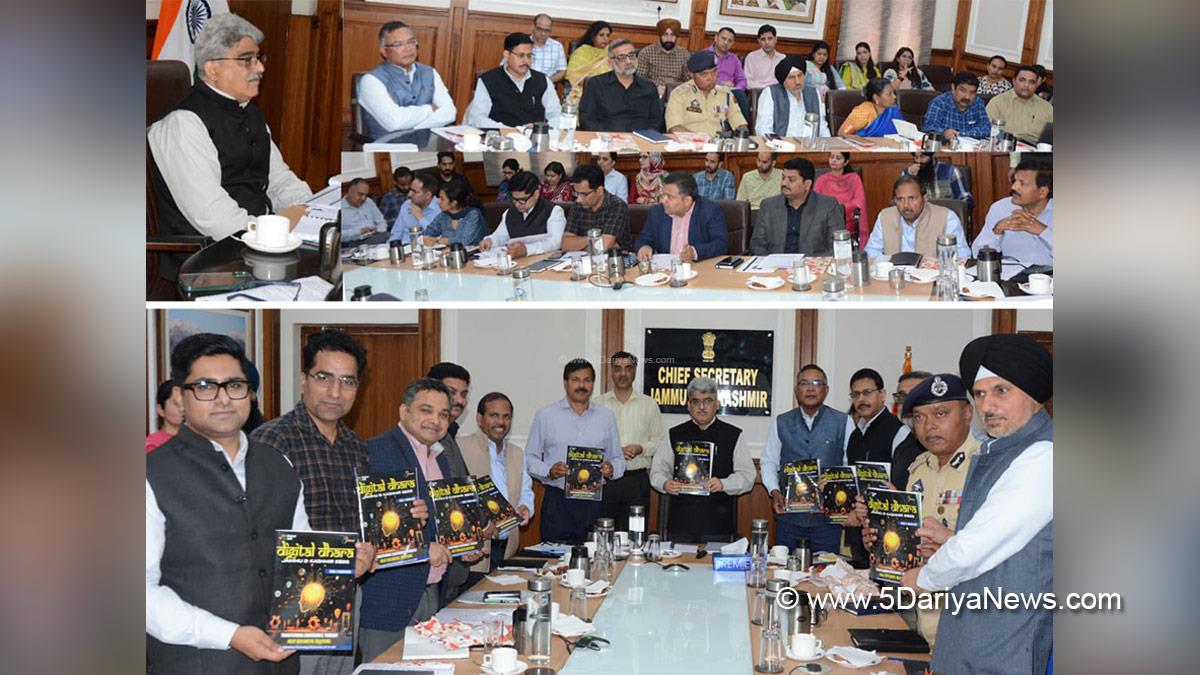
Chief Secretary Atal Dulloo reviews roadmap for AI adoption across departments; Centre of Excellence and Data Labs proposed
JAMMU: The Jammu and Kashmir administration is moving to harness the power of Artificial Intelligence to modernise governance and improve citizen services across the Union Territory.
Chairing a high-level meeting on Monday, Chief Secretary Atal Dulloo held detailed deliberations with key stakeholders on the adoption and expansion of AI-driven solutions in governance.
The meeting was attended by senior administrative secretaries along with representatives from leading technical institutions including Indian Institute of Technology Jammu, the IndiaAI Mission and Bhaskaracharya National Institute for Space Applications and Geo-informatics.
During the meeting, participants explored how AI-based technologies can be integrated into citizen-centric sectors to enhance administrative efficiency, data-driven decision making and accessibility of government services.
Addressing the officials, the Chief Secretary said Artificial Intelligence has the potential to transform governance in Jammu and Kashmir by improving transparency, service delivery and policy outcomes. He urged all departments to proactively identify areas where AI-based tools could enhance efficiency and bring measurable improvements in their respective sectors.
Dulloo also stressed the need for strong coordination between the Union Territory administration, the concerned Union ministries and leading technical institutions such as IIT Jammu and BISAG-N to ensure timely implementation of AI-enabled initiatives.
To provide strategic direction, the Chief Secretary proposed the formation of a high-level Steering Committee to oversee AI projects in the Union Territory. The committee would be chaired by the Additional Chief Secretary of the Public Works Department and include representatives from IIT Jammu, BISAG-N, the Information Technology Department and the police department.
He also directed the Information Technology Department to create a dedicated mechanism within the department to coordinate AI-related initiatives across various government departments and ensure effective implementation on the ground.
Highlighting the importance of capacity building, Dulloo emphasised the need to establish a Centre of Excellence in Emerging Technologies in Jammu and Kashmir, along with Data Innovation Labs in skill development institutions. These initiatives, he said, would help prepare the region for future technological challenges and develop a skilled workforce in artificial intelligence and data science.
The Chief Secretary further suggested that the School Education Department explore the introduction of basic Artificial Intelligence courses at the secondary school level to familiarise students with emerging technologies at an early stage.
He also recommended integrating AI-related skill programmes under Mission YUVA to enable young people to gain expertise in new-age technologies and enhance their employment prospects.
During the meeting, officials from various departments shared proposals on using AI tools for improving governance, including data analysis, public service delivery and policy planning.
Abhishek Singh suggested creating a dedicated core AI team within the Union Territory to guide the implementation of AI initiatives locally. He also recommended identifying five priority sectors for pilot-based implementation before gradually scaling up successful projects.
Director of Indian Institute of Technology Jammu, Manoj Gaur, described the initiatives as timely and significant. He said the institute has strong research capabilities in disaster mitigation and risk reduction, which could support AI-driven governance solutions in the region. He also highlighted ongoing work on developing data pipelines in local languages to strengthen AI applications.
Meanwhile, Vinay Thakur assured full support from BISAG-N in implementing AI-based governance solutions in Jammu and Kashmir. He also emphasised the need for a dedicated Project Management Unit (PMU) to ensure smooth execution and monitoring of the proposed initiatives.
Providing an update on the law-enforcement sector, Bhim Sen Tuti informed the meeting that the police department has developed an AI-based investigative tool aimed at improving investigation and litigation processes. The system, currently in an advanced stage, has been designed to function entirely in-house without internet connectivity.
Earlier, Secretary Information Technology Piyush Singla briefed the meeting on the progress made in leveraging AI for governance. He said a ₹20-crore Detailed Project Report (DPR) for establishing a Centre of Excellence in Emerging Technologies has been jointly prepared by the IT Department and IIT Jammu and submitted to the Ministry of Electronics and Information Technology for approval under a 90:10 Centre-UT funding pattern.
He also informed that eight Data Innovation Labs are proposed to be established in Industrial Training Institutes across the Union Territory with central funding to strengthen the AI and data ecosystem at the grassroots level.
The meeting identified several potential AI applications across governance sectors, including disaster risk management and early warning systems, agriculture and horticulture advisory services, health triage and disease surveillance, office workflow automation, AI-supported learning platforms, land and infrastructure monitoring, youth skill-matching systems and AI-based grievance redressal mechanisms.
On the occasion, the Chief Secretary also launched the inaugural issue of ‘Digital Dhara’, a bi-monthly magazine of the Information Technology Department. The publication aims to promote digital awareness, highlight technological innovations and document key milestones in IT-enabled governance in Jammu and Kashmir.