

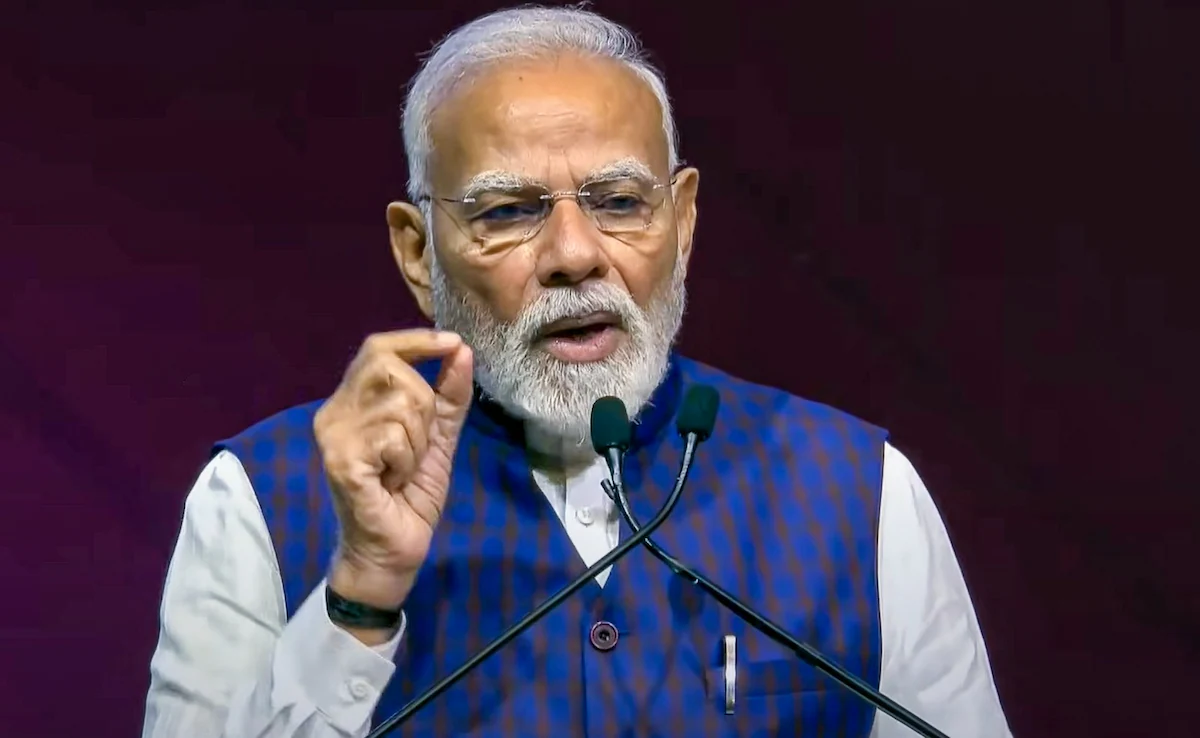
NEW DELHI: Prime Minister Narendra Modi on Thursday said India has developed a robust and inclusive digital public infrastructure and is sharing it with the world, underscoring that for India, technology is a tool for service—not dominance—and empowerment—not control.
Addressing the Leaders’ Plenary Session at the India AI Impact Summit at Bharat Mandapam, the Prime Minister emphasised that while past technological revolutions sometimes deepened divides, artificial intelligence must now be made accessible, inclusive and within everyone’s reach.
He stressed that as the world shapes the future of AI governance, the aspirations and priorities of the Global South must remain central to the conversation. Welcoming delegates from across the globe, Modi expressed confidence that the summit would contribute meaningfully to building a human-centric, ethical and sensitive global AI ecosystem.
“History shows that humanity has repeatedly transformed disruption into opportunity. We stand at such a moment again—where disruption can become humanity’s greatest opportunity,” he said.
Highlighting India’s digital transformation, Modi noted that the country’s digital public infrastructure has empowered millions and is now being offered as a global public good. “For India, technology is not a means of power, but of service; not to dominate, but to empower. AI must follow the same path—serving humanity and advancing collective welfare,” he said in the presence of global leaders.
He pointed to the success of the Unified Payments Interface (UPI), which enabled seamless digital transactions even in challenging conditions and significantly bridged the digital divide. He also noted that India is equipping its startups with world-class computing power at highly affordable costs.
Underlining India’s commitment to open innovation, the Prime Minister mentioned AIKosh, the National Dataset Platform, through which over 7,500 datasets and 270 AI models have been shared as national resources to accelerate research and development.
Modi reaffirmed that India’s AI vision is clear and principled: AI must be treated as a shared resource for the welfare of humanity. Quoting Lord Buddha—“Right Action comes from Right Understanding”—he stressed the importance of informed, ethical and timely decision-making to ensure AI delivers positive outcomes.
Describing “aspirational India” as a key stakeholder in the global AI journey, he said the country recognises its responsibility and is taking decisive steps. However, he cautioned that while ethics has always guided human progress, the scale of potential misuse with AI is unprecedented.
“Ethical standards for AI must be equally expansive,” he said, urging AI companies to look beyond profit and prioritise purpose, responsibility and long-term societal impact.
The Prime Minister offered three key principles for ethical AI development. First, AI training must respect data sovereignty and operate within a trusted global data framework. Referring to the principle of “garbage in, garbage out,” he warned that unreliable or biased data inevitably leads to flawed outcomes.
Second, AI platforms must adopt transparency through a “glass box” approach rather than a “black box” model—ensuring safety protocols are visible, verifiable and accountable.
Third, AI must be firmly anchored in human values. Citing the “paperclip problem”—a thought experiment illustrating how a machine pursuing a single unchecked objective could exhaust global resources—Modi emphasised that while technology is powerful, its direction must always remain under human guidance.
He observed that AI is already shaping learning, intelligence and emotional experiences at an individual level, making ethical safeguards even more essential.
Drawing lessons from the COVID-19 pandemic, Modi said the world witnessed how collaboration can overcome even the most daunting challenges. From vaccine development to supply chains and data-sharing, global cooperation saved millions of lives. He cited India’s digital vaccination platform as an example of how technology can effectively serve humanity at scale.
Highlighting India’s growing AI infrastructure, he noted that under the India AI Mission, 38,000 Graphics Processing Units (GPUs) are already operational, with an additional 24,000 set to be added in the next six months.
Concluding his address, the Prime Minister called for building an AI future that accelerates innovation, strengthens inclusion and remains firmly rooted in human values. “When technology advances alongside trust, its true transformative impact becomes visible across the world,” he said.