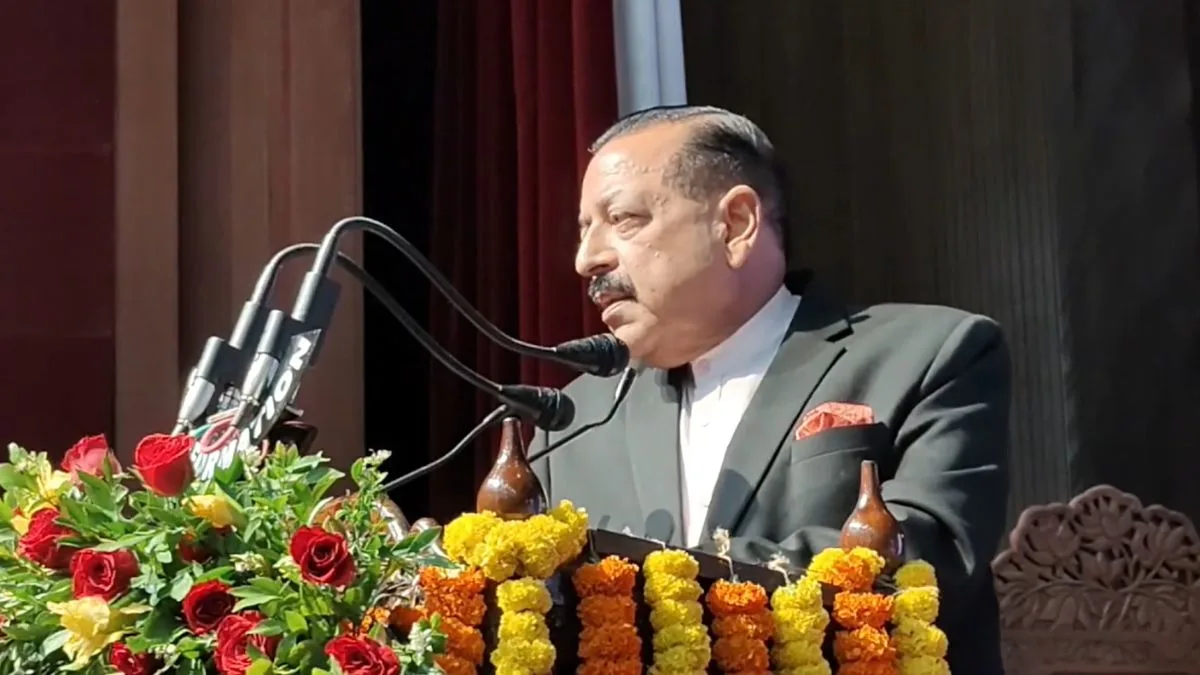
JAMMU: Union Minister of State (Independent Charge) for Science and Technology and MoS in the Prime Minister’s Office, Dr Jitendra Singh, on Tuesday said that the transition to the e-Office system in Jammu and Kashmir has saved crores of rupees that were earlier spent on transporting official files between Jammu and Srinagar during the biannual Durbar Move.
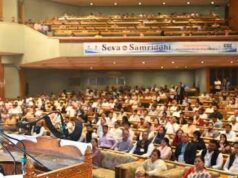
Dr Singh was addressing the National Governance Conference on “Holistic Development of Districts” held in Jammu. The conference was attended by Chief Minister Omar Abdullah, Chief Secretary Atal Dulloo, Union Secretary Department of Personnel and Training (DoPT) Rachna Shah, and senior officers from the Central and Union Territory governments.
Highlighting administrative reforms in Jammu and Kashmir, the Union Minister said that the Department of Administrative Reforms and Public Grievances (DARPG) under the Union Ministry of Personnel helped the UT government implement the e-Office system, which has significantly improved efficiency and reduced administrative costs.
He noted that earlier, thousands of official files had to be physically transported between Jammu and Srinagar during the Durbar Move, incurring huge logistical expenses. The digital system, he said, has not only reduced expenditure but also enhanced transparency and faster decision-making.
Dr Jitendra Singh said that Jammu and Kashmir has immense potential to contribute to India’s growth story and can play a significant role in achieving the country’s vision of “Viksit Bharat.” He added that the Centre is taking governance to remote regions to ensure inclusivity and wider public participation.
Referring to governance reforms under the leadership of Prime Minister Narendra Modi, the minister said the government is guided by the principle of “Minimum Government, Maximum Governance,” which emphasizes greater use of technology and reduced human interface in administrative processes.
He pointed out that nearly 90 percent of the Government of India’s work processes are now conducted online, describing it as the effective use of technology to modernize governance.
The Union Minister also highlighted several key initiatives aimed at improving governance, including the Aspirational Districts Programme, which encourages districts to adopt best practices through competitive and cooperative federalism.
Dr Singh said the government has also undertaken major reforms over the past decade, including the removal of nearly 2,000 obsolete rules, pension reforms to enhance inclusivity, the abolition of interviews for certain government recruitments, and the discontinuation of the requirement for attestation by gazetted officers.
On grievance redressal, he highlighted the role of the Centralized Public Grievance Redress and Monitoring System (CPGRAMS), noting that nearly 90 percent of grievances are resolved within a week.
The minister also spoke about Mission Karmayogi, a major capacity-building initiative aimed at transforming governance from a rule-based to a role-based system. He said that a tripartite MoU between the Government of Jammu and Kashmir, the Capacity Building Commission, and Mission Karmayogi has been finalized to bring around 3.6 lakh J&K government employees onto the iGOT platform for continuous training and skill development.
He added that Artificial Intelligence integration of the JK-IGRAM grievance redressal system is also being planned to improve efficiency in handling public complaints.
Dr Jitendra Singh further outlined several governance reforms introduced in Jammu and Kashmir over the past decade, including the introduction of online RTI services, the establishment of a Central Administrative Tribunal bench, and the setting up of a Civil Services Examination Centre in Leh.
He also referred to the SVAMITVA Scheme, which provides legal ownership records to rural landowners and has empowered many residents in Jammu and Kashmir.
Addressing the conference, Union Secretary DoPT Rachna Shah emphasized that governance systems must continuously adapt and evolve in the information age. She said modern governance must be data-driven, digital, and delivery-oriented, as citizens today demand greater transparency, accountability, and efficiency.
She also highlighted the importance of strengthening grievance redress mechanisms through CPGRAMS, with greater focus on timely and empathetic resolution of complaints. The platform, she added, is being further upgraded with Artificial Intelligence tools to improve complaint categorization and faster resolution.
The conference highlighted the critical role of districts as key administrative units in driving development and provided a platform for sharing best practices and innovative governance models.
The deliberations reaffirmed the commitment of the Government of India and the Jammu and Kashmir administration to strengthen governance frameworks and accelerate inclusive development in line with the vision of Viksit Bharat.
J&K’s Shift to e-Office Saved Crores During Durbar Move: Dr Jitendra Singh

- Advertisement -