NEW DELHI: Prime Minister Narendra Modi on Friday launched a strong attack on the Indian National Congress, criticising its youth wing’s shirtless protest at the recent AI Impact Summit. He said that while the opposition may “tear as many clothes as it wants,” his government would remain focused on India’s development.
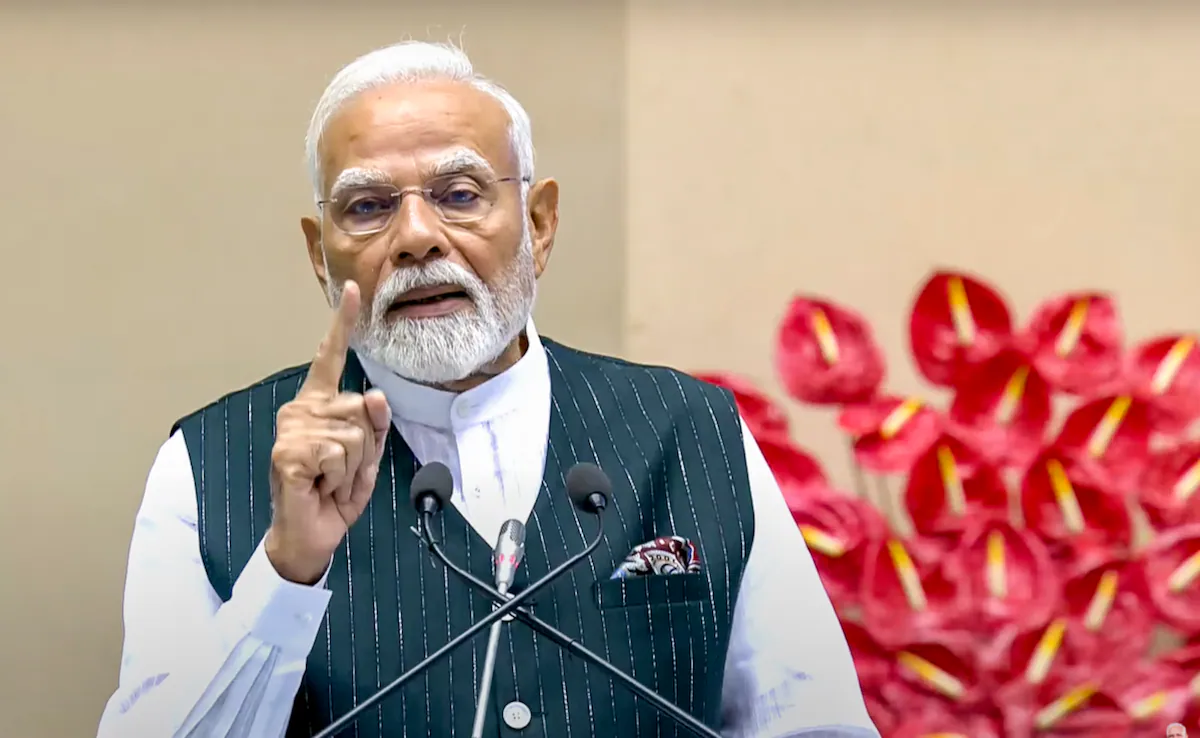
Speaking at the News18 Rising Bharat Summit, the Prime Minister said the Congress had not only embarrassed itself in front of foreign delegates but had also exposed what he described as its “intellectual bankruptcy.” He asserted that millennials had already rejected the party and that Gen-Z voters were now prepared to do the same.
In an apparent jibe at Leader of Opposition Rahul Gandhi, Modi referred to Gandhi’s praise for the “Babbar Shers” (lions) of the Indian Youth Congress who staged the protest. The Prime Minister said those “lions” had fled after facing public backlash.
“Congress ke Babbar Sher logon ki jute kha ke bhaag gaye (The Congress ‘lions’ ran away after being hit by shoes by the public),” Modi remarked, referring to reports of Youth Congress workers being heckled during the protest.
On February 20, members of the Indian Youth Congress staged a dramatic protest inside Hall No. 5 of the summit venue in Delhi, removing their shirts to reveal T-shirts bearing anti-government slogans. The incident triggered a political confrontation between the BJP and the Congress.
Calling the AI Summit a “moment of pride” for the nation, Modi accused the Congress of attempting to tarnish the event. “When frustration and the despair of failure dominate the mind, and arrogance clouds judgment, such actions are taken to defame the country,” he said during his nearly 45-minute address.
The Prime Minister also alleged that the Congress habitually invokes Mahatma Gandhi to shield its failures while attributing all positive developments to one political family.
“In a democracy, the opposition’s role is not merely to oppose every decision, but to present an alternative vision,” Modi said, adding that voters were increasingly rejecting what he called Congress’ politics of obstruction.
Highlighting the party’s electoral decline, Modi pointed out that in 1984 the Congress secured 39 per cent of the vote and more than 400 seats in the Lok Sabha. Today, he said, the party has over 50 MLAs in only four states, reflecting a steady erosion of public support.
Turning to India’s global standing, Modi credited his government’s reforms for boosting investor confidence and strengthening institutions, leading developed nations to pursue trade agreements with India.
“If India were still trapped in the policy paralysis of the pre-2014 era and counted among the ‘Fragile Five,’ no country would have sought trade deals with us,” he said.
The Prime Minister argued that centuries of colonial rule had instilled a mindset of inferiority, which persisted even after Independence. However, he said a “confident India” was now emerging, shedding that legacy and reclaiming its global position.
“Over the past 11 years, a new energy has flowed into the nation’s consciousness. India is no longer just a consumer of technology — we are developing it and setting global standards,” he said.
Modi cited India’s digital public infrastructure as an example of its growing global influence, adding that the AI Summit itself demonstrated how closely the world is watching India’s progress.
Referring to the government’s vision of ‘Viksit Bharat by 2047,’ he described it not as a political slogan but as a long-term national mission aimed at correcting past policy shortcomings and building a self-reliant India.
He further noted that while India and the Global South were largely followers in previous industrial revolutions, the country is now actively shaping the artificial intelligence era with its expanding AI startup ecosystem.
Highlighting infrastructure achievements, Modi said India has emerged as one of the world’s leading nations in solar power capacity, expanded its Metro network to become the third largest globally, and introduced semi-high-speed rail services such as Vande Bharat and Namo Bharat.
“Nation-building does not happen through short-term thinking,” he said. “It requires long-term vision, patience, and timely decisions.”(PTI)