JAMMU, FEBRUARY 15: The Department of Science and Technology (DST) is undertaking efforts to chart a futuristic roadmap for the development of the biotechnology sector in Jammu and Kashmir, including the formulation of a dedicated Union Territory Biotechnology Policy.
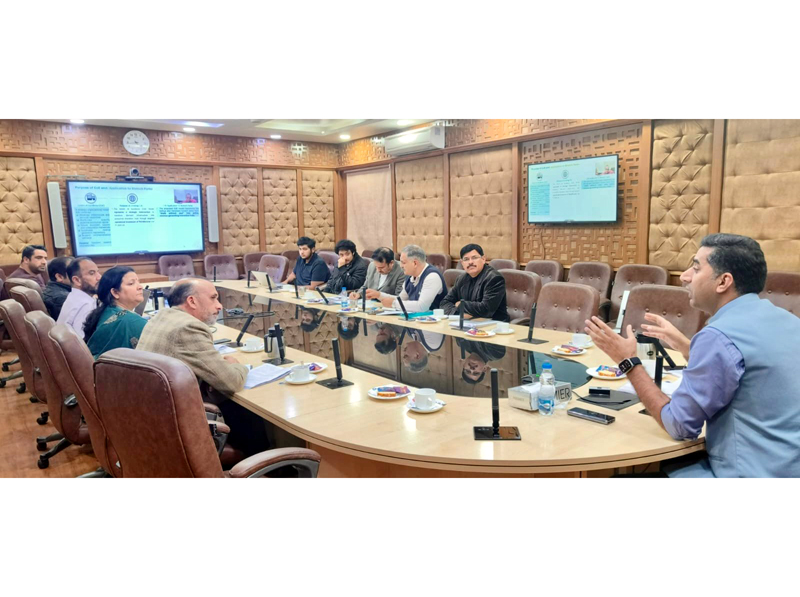
In this regard, Commissioner Secretary, Science and Technology, Dr. Shahid Iqbal Choudhary, today chaired a comprehensive review meeting during which senior officers presented findings from their extensive study visits to India’s leading biotechnology clusters, including Genome Valley, Guwahati Biotech Park, and biotechnology facilities at Lucknow, Visakhapatnam and Chandigarh.
The delegation, comprising Special Secretary Reyaz Ahmed Beigh, Director Finance Madan Lal, Additional Secretary JKSTIC Neelam Khajuria, Additional Director Dr. Mushtaq Ahmed, Deputy Secretary Asif Chandel and other officers, examined operational models, technology incubation frameworks and industry–academia linkages at these established biotech hubs.
Deputy Secretary Dr. Abdul Khabir delivered a detailed presentation outlining global best practices and identifying sector-specific opportunities for Jammu and Kashmir.
During the meeting, Dr. Shahid Iqbal directed the immediate formulation of a comprehensive J&K Biotechnology Policy, noting that the Union Territory stands at the confluence of extraordinary natural resources and largely untapped scientific potential.
With more than 6,500 plant species, including over 200 high-value medicinal and aromatic varieties such as saffron, lavender, wild mushrooms and rare herbs, and diverse agro-climatic zones ranging from subtropical Jammu to alpine Kashmir, J&K possesses inherent advantages that remain underutilized in India’s rapidly expanding bioeconomy, currently valued at approximately $130 billion and projected to reach $300 billion by 2030 under the national BioE3 Policy framework.
The Commissioner Secretary emphasized that the proposed policy will strategically focus on agricultural biotechnology for crop improvement and climate resilience; pharmaceutical manufacturing leveraging J&K’s rich phytochemical biodiversity; food processing and nutraceutical development based on horticultural produce; dairy biotechnology for probiotic innovations; industrial enzyme production; and environmental bioremediation initiatives for water bodies such as Dal and Wular lakes.
The policy framework aims to build upon J&K’s existing strengths while creating new value chains in bio-manufacturing, enabling a transition from raw material exports to high-value biotechnology products.
Addressing the challenge of youth employment, Dr. Shahid Iqbal proposed the introduction of a structured internship programme for biotechnology graduates from institutions across J&K, creating direct pathways between academic training and industrial application. The initiative seeks to bridge the gap between qualified graduates and sector-relevant employment opportunities within the Union Territory.
The Department is currently operationalizing two Department of Biotechnology (DBT)-funded Industrial Biotech Parks at Kathua in the Jammu region and Handwara in the Kashmir region, representing a combined Government of India investment of ₹84.66 crore, as Centres of Excellence in Industrial Biotechnology.
These facilities are envisioned to evolve from infrastructure assets into active innovation hubs supporting startup incubation, technology commercialization and research and development in fermentation technologies, enzyme production, herbal extraction and analytical testing.
The recently announced budget outlay is expected to activate these parks as centres attracting scientific talent and entrepreneurial investment. Drawing lessons from Genome Valley’s public–private partnership model and the incubation success of Guwahati Biotech Park, the DST’s vision positions J&K’s biotechnology ecosystem within a broader convergence framework.
Strategic collaborations with SKUAST-Jammu and SKUAST-Kashmir, along with the pharmaceutical research capabilities of CSIR-Indian Institute of Integrative Medicine, will provide the intellectual foundation for translating indigenous knowledge into patents, products and economic growth.
The Commissioner Secretary underscored that biotechnology represents not merely a policy priority but a transformative pathway—converting J&K’s biodiversity into biowealth, its scientific institutions into engines of innovation, and its youth into a skilled workforce prepared for India’s emerging bio-manufacturing era.